
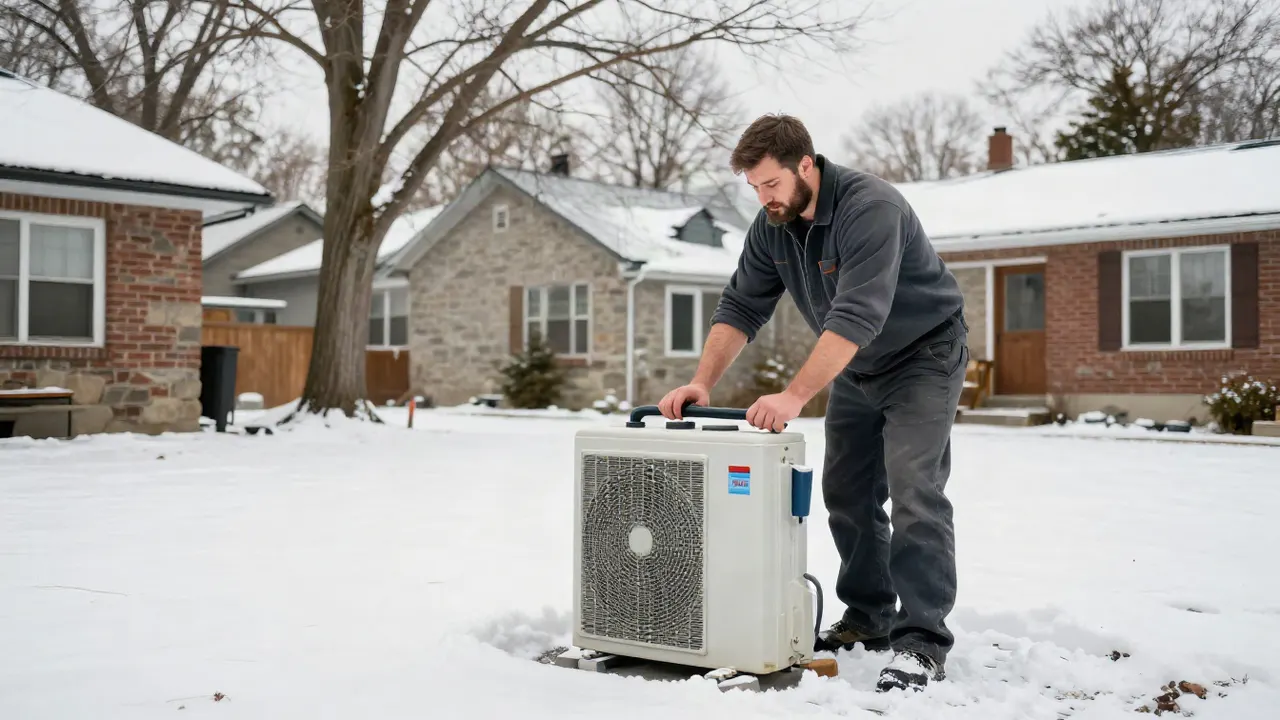
A thin, even layer of white frost on the outdoor unit is normal and means your heat pump is working. A solid block of ice that swallows the coil, jams the fan, or creeps up the cabinet is not normal - it means the defrost cycle has stopped clearing the coil, and the unit is losing capacity every hour it stays frozen. In Ottawa, where January design temperatures sit near -24°C and we routinely string together two-week stretches below -15°C, that distinction matters more than it does in almost any other Canadian city.
Heat pump ice buildup in Ottawa winters and what it means comes down to one question: is the unit shedding frost on schedule, or is it accumulating ice faster than it can melt it? The rest of this post covers how to tell the difference, what causes each failure, what ice removal and repair cost here in 2026, and when to stop troubleshooting and call someone.
Why does my heat pump have ice buildup in Ottawa winters?
Ice builds up because a heat pump pulls heat out of cold outdoor air, which chills the outdoor coil below freezing and condenses moisture out of the air onto the fins. That moisture freezes. Every air-source heat pump does this, in every cold climate, on every heating cycle - the ice itself is a byproduct of the machine working, not a sign it has failed.
The unit is supposed to reverse itself every 30 to 90 minutes and run in cooling mode for a few minutes to melt that frost off. When it does, you will see steam rising off the top of the cabinet and hear a whoosh as the reversing valve shifts. That is normal. What is not normal is frost that survives the defrost cycle, thickens into a shell, and starts bridging the gap between the coil fins.
Ottawa stacks three conditions on top of each other that make this worse than it is in, say, Vancouver or Toronto:
- Long cold snaps. Below about -15°C, the air holds very little moisture, so frost accumulates slowly - but the defrost cycle also has less latent heat to work with, and any ice that does form takes longer to melt.
- Freezing rain and ice pellets. The Ottawa Valley gets more of both than most of Ontario. A single freezing rain event can glaze the fan blades and the top grille in a way that a normal defrost cycle cannot clear.
- Snow loading. Units mounted at grade get buried by plow drift. A snow-packed cabinet insulates the coil, traps meltwater, and refreezes it into a solid block overnight.
If you are in one of the newer west-end subdivisions, this is a conversation we have constantly - heat pump installation in Kanata almost always involves a conversation about mounting height, because grade-level pads in open subdivisions drift in badly.
Is ice on my heat pump normal in Ottawa, Ontario?
Yes, some ice is normal - but the amount, the location, and how long it lasts tell you whether you have a problem. Here is the line we draw when we are standing in front of a unit:
- Normal: light, even frost across the coil during a heating cycle, clearing within 5 to 10 minutes of the defrost cycle starting. A little ice at the bottom of the cabinet in a deep freeze is common.
- Watch it: frost that survives two or three defrost cycles, ice forming on the fan blades, or a visible sheet of ice on the top grille after freezing rain.
- Not normal: a solid block of ice around the coil, ice thick enough to bend the fan blades, ice climbing the cabinet sides, or water pooling and refreezing under the unit.
The single best test is the defrost cycle itself. Stand outside with a coffee for 20 minutes during a cold snap and watch. If the unit never shifts into defrost, or shifts but the ice does not retreat, you have a defrost problem - not a weather problem.
How the defrost cycle actually works
The defrost cycle is a controlled, temporary reversal of the refrigeration cycle, triggered by a sensor on the outdoor coil and a timer on the control board. When the coil temperature drops far enough below freezing for long enough, the board tells the reversing valve to flip, the outdoor fan shuts off, and the unit runs in cooling mode - pulling heat from inside the house and dumping it into the outdoor coil to melt the frost.
A few things have to be true for this to work:
- The coil temperature sensor has to be reading accurately. A drifted or failed sensor is the number one cause of a unit that never enters defrost.
- The reversing valve has to actually shift. If it sticks, the unit stays in heating mode and the ice keeps growing.
- The control board has to be sending the signal. Boards fail, especially on units that have been through 10 or 12 Ottawa winters.
- The outdoor fan has to stop during defrost. If it keeps running, it blows cold air across the coil and fights the melt.
There is also a fifth factor that has nothing to do with the machine: refrigerant charge. A system that is 10% low on refrigerant runs a colder coil, builds frost faster, and can ice up even when every control is working perfectly. That is why we pressure-test before we replace a board.
If you are running an older single-stage unit that has been icing up for two or three seasons, the honest answer may be that it is time for a heat pump replacement in Ottawa, Ontario rather than another repair. A modern cold-climate inverter unit handles -25°C far better than a 2010-era unit ever did.
How do I fix heat pump ice buildup in Ottawa?
You fix it in two stages: safely clear what you can from outside, then diagnose why the defrost cycle stopped working. Do not chip at the ice with a screwdriver, do not pour hot water on the coil, and do not run the unit in cooling mode to melt it - all three damage the coil or the compressor.
Here is the sequence we walk homeowners through on the phone:
- Switch the system to emergency or auxiliary heat at the thermostat so the outdoor unit stops running. If you have a hybrid or dual-fuel setup, this is a one-button fix.
- Clear snow from around the cabinet - at least 18 inches of clearance on all sides and above. Snow-packed units cannot defrost.
- Let it melt on its own if the outdoor temperature is above -5°C. It usually takes 2 to 4 hours. If it is colder, a garden hose with lukewarm (not hot) water on the coil is safe.
- Restart the system and watch one full defrost cycle. If ice returns within 24 hours, the problem is mechanical or electrical, not weather.
If the ice comes back, the cause is almost always one of five things: a failed defrost sensor, a stuck reversing valve, a bad control board, low refrigerant, or a clogged outdoor coil from cottonwood seed and fall debris. A technician can identify which one in about 45 minutes with a multimeter and a set of gauges.
One more thing worth checking while you are outside: the mounting. Units sitting on the ground in Ottawa's freeze-thaw cycle end up sitting in meltwater that refreezes around the base. A wall bracket or a raised stand solves it permanently. We spec that on every cold climate heat pump installation in Ottawa, Ontario for exactly this reason.
What ice buildup costs to fix in Ottawa in 2026
Typical 2026 pricing in Ottawa for heat pump ice repair runs from about $180 for a diagnostic and manual defrost up to $1,400 or more if a reversing valve or control board has to be replaced. Here is the range we see most often:
- Diagnostic visit and manual defrost: $150-$250
- Defrost sensor or thermistor replacement: $220-$400 installed
- Control board replacement: $600-$1,100 installed, depending on brand
- Reversing valve replacement: $900-$1,400 installed, plus refrigerant recovery and recharge
- Refrigerant leak repair and recharge: $400-$900 depending on how much R-410A or R-32 is needed
If the unit is more than 12 years old and the repair is over $800, we usually recommend putting that money toward a new system instead. A modern cold-climate unit will cut your heating bill by 30-50% compared to a 2012-era heat pump running on resistance backup, and the federal Greener Homes-style rebates that were available through 2025 have been replaced by provincial and utility programs that still cover a meaningful chunk of the install.
Common mistakes we see every January
The mistakes that turn a $200 sensor replacement into a $1,400 compressor job are almost always made in the first hour, by a homeowner trying to help. We see the same five every winter:
- Chipping ice off with a screwdriver or hammer. The coil fins are aluminum and about as thick as a soda can. One slip punctures a refrigerant line.
- Pouring boiling water on the unit. Thermal shock cracks the coil and can shatter the fan blade.
- Running the system in cooling mode to melt the ice. This pulls heat out of your house and can slug the compressor with liquid refrigerant.
- Shovelling snow against the cabinet. It feels tidy. It also insulates the coil and traps meltwater.
- Ignoring it because "it still heats." A partially iced unit still produces heat - at 60% of rated capacity, with the backup heat element running constantly and your hydro bill climbing.
If you have already done one of these, stop and call. We would rather replace a sensor than a compressor.
When to call a professional
Call a technician if the ice has not cleared within 24 hours of switching to auxiliary heat, if you see ice on the fan blades or cabinet sides, if the unit is short-cycling, or if you hear grinding, hissing, or a metallic rattle when the defrost cycle starts. Those are all signs of a mechanical fault that will not fix itself.
We handle frozen heat pumps across the city every winter, including emergency calls during cold snaps. If you are in the older neighbourhoods where units are often tucked tight against the house, we see this constantly - heat pump installation in Westboro almost always involves solving a clearance problem, because a 1920s lot does not leave much room for an outdoor unit.
Our technicians carry defrost sensors, reversing valves, and control boards for the major brands on the truck, so most ice-related repairs are done in a single visit. We quote the repair before we start, and if the honest answer is that a replacement makes more financial sense, we will tell you that instead.
Frequently Asked Questions
Why does my heat pump have ice buildup in Ottawa winters?
Because Ottawa's long cold snaps, freezing rain, and snow loading overwhelm the defrost cycle. The coil runs below freezing, moisture condenses and freezes, and if the defrost sensor, reversing valve, or control board fails, that frost never melts. Below -15°C the melt is slower and the buildup wins.
Is ice on my heat pump normal in Ottawa, Ontario?
Light, even frost during a heating cycle is normal and should clear within 5-10 minutes of defrost starting. A solid block of ice, ice on the fan blades, or frost that survives three defrost cycles is not normal and needs a technician.
How do I fix heat pump ice buildup in Ottawa?
Switch to auxiliary heat, clear snow 18 inches around the cabinet, and let it melt for 2-4 hours. If ice returns within 24 hours, the defrost sensor, reversing valve, board, or refrigerant charge is at fault. Never chip at the ice or pour hot water on the coil.
Who repairs frozen heat pumps near me in Ottawa?
Ottawa Heat Pump repairs frozen units across the city, including Kanata, Barrhaven, Orléans, Nepean, and Westboro. Most ice-related repairs - sensors, boards, reversing valves - are completed in a single visit, and we quote the repair before we start.
How much does heat pump ice repair cost in Ottawa, Ontario?
In 2026, most ice repairs in Ottawa run $150-$250 for a diagnostic and defrost, $220-$400 for a defrost sensor, and $600-$1,400 for a control board or reversing valve. If the unit is over 12 years old and the repair exceeds $800, replacement usually makes more sense.
Get help with Heat Pump Installation in Ottawa
If your outdoor unit is iced up and the defrost cycle is not clearing it, we can diagnose it, repair it, or replace it - and we will tell you honestly which one makes sense. Call Ottawa Heat Pump at 333-444-888 and we will get a technician out to look at it.